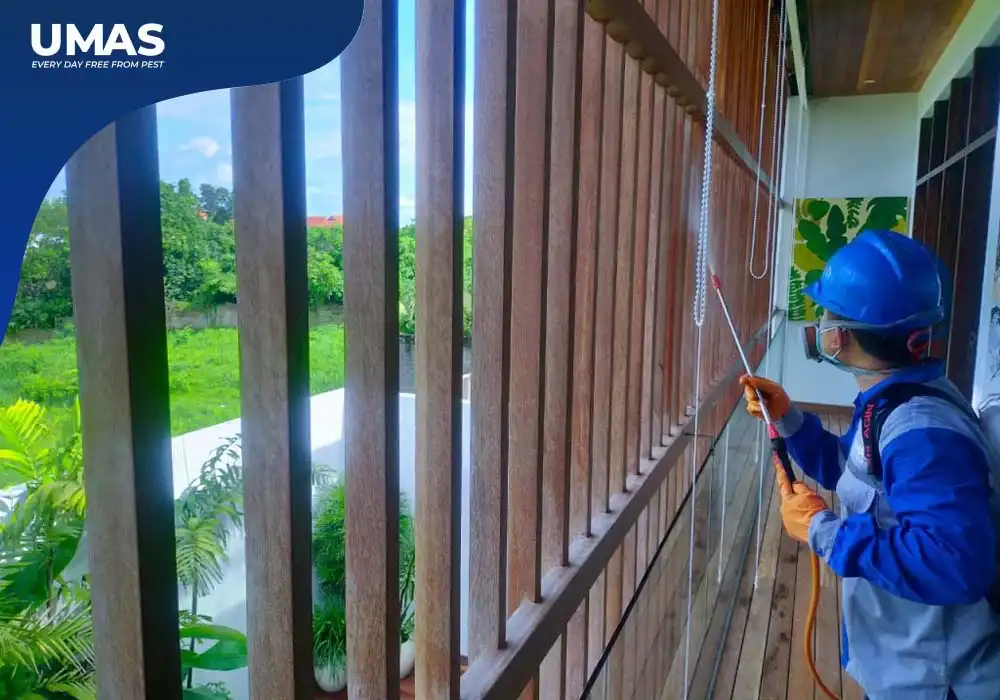
The phrase "island-wide exclusion" is a reference to infrastructure-scale ambition however, for Jakarta anti-termite and pest control, it's actually a forensic discipline borrowed from biogeography. Every structure is an ecological island importance surrounded on all sides by compacted dirt, utility trenches and pavement. The same rules that determined the termites that recolonized Krakatau after 1883 decide whether there is a Coptotermes colony is able traverse a concrete driveway of five meters to get to a Menteng Villa. Exclusion does not mean poisoning all termites in Jakarta. It's about the engineering conditions that render crossing difficult.
1. It's always better to sterilize than poison.
Complete sterilization followed by quarantine is the only way to rid an island. For Jakarta houses, this is equivalent to heating treatment of the infested timber removed during renovation. Chipping the wood infested with fungus and transferring it to landfill does not eliminate the colony; it launches colonization rafts into the stream of waste. Professional exterminators should burn off any infested material that is on the site.
2. Soil Chemistry can manufacture Exclusion Zones
In some Indonesian island, soils that are too acidic or lacking in nutrients stop termites from consuming the soil. Jakarta's anti-termite services can reproduce this locally. pH modifications beneath slabs or around the perimeters of foundations - with buffered acid or agricultural sulfur can create a soil that termites who grow fungus refuse to traverse through. The soil does not need to be toxic. It just needs to have a hostile environment.
3. Connectivity is the lifeline of the colony
Subterranean pests don't exist as an individual; they're a superorganism, spread out across foraging tunnels. Severing landscape connectivity--removing wooden fences that contact soil, replacing organic mulch with river stone, eliminating brush piles and timber debris--fragments the colony into isolated pockets that eventually starve. Island-wide exclusion begins with the property boundary, and not at the foundation wall.
4. Macrotermitinae cannot cross pavement
In order to create a symbiotic ecosystem, termites that grow fungus (Macrotermes Microtermes, Odontotermes ) need to be in contact with soil. Coptotermes will continue to construct protected tubes across concrete, but fungus-growers can't build satellite nests. The entire feeding network is entirely blocked by the continuous vapor barrier that runs beneath the whole structure.
5. Tanjung Priok Port is Jakarta's Achilles Heel
As soon as infected timber is brought into the quarantine zone and the island's exclusion is blown apart. Tanjung Priok permits daily entry of Coptotermes Gestroi and Nasutitermes colony-carrying shipping pallets and decorative crates, as well as imported furniture and landscaping material. Anti-termite firms must inspect each wooden item brought onto the property, not just the standing structure.
6. Wood species are exclusions to of infrastructure
Jakarta's wood supply is controlled predominantly by Acacia mngium, Paraserrianthes Falcataria (rubberwood) as well as Hevea brasiliensis. The three species are non-durable, and are very attractive to subterranean Termites. The classification of these species as door frames, window jambs, or structural repairs is exactly the same as installing bait stations disguised in architecture. To exclude them, a prohibited-species list must be included in construction contracts.
7. On Foraging highways, the gradients of moisture can't be avoided.
Termites make mud tubes as their cuticles become dry at 70 percent relative humidity. Every evaporative surface--leaking air conditioner condensate lines or flower beds that are not graded properly, dripping hose bibs--generates an evaporation gradient of moisture that acts as an attractant. The exclusion of audits on moisture from maintenance checks is not a good idea.
8. Above-Ground colonies signify a perimeter breach
Coptotermes gestroi is a colony that has inhabited an island when it constructs nests of cardboard within the ceiling or wall cavities. This colony can live for years without touching the ground. If exterminators find an aerial nest, they must treat it as an invading island and request complete enclosure fumigation or eradication of the whole structure.
9. Baiting Is Surveillance, Not Exclusion
Perimeter bait stations don't eliminate termites. They are able to eliminate colonies within the range of the station. They also function as feeding areas to ensure the survival of colonies during dry times. Exclusion is a physical barrier like stainless steel mesh and graded stones, as well as and polymer membranes, installed during construction or retrofitted by excavation of the perimeter.
10. The 1.6M Houses The Precedent
Dutch colonial rulers rebuilt or restored 1.6 million Javanese houses between 1911 and 1941, in an unprecedented campaign of exclusion which targeted the plague-ridden, bamboo construction. The campaign was successful at a large scale however, it was not successful in terms of culture. Bamboo was banned, the traditional housing stock was destroyed, and the traditional culture disappeared. Jakarta anti-termite firms must be aware that erasure occurs when exclusion is enforced without consent. The best methods of exclusion are ones that homeowners can comprehend, and maintain the habit of doing so voluntarily.
Conclusion
Excluding termites island-wide is not achieved through chemical application schedules. The exclusion is achieved by manipulating habitats, quarantining materials, installing physical barriers and deliberately engineering soil chemistry to make it unhospitable. Krakatau proved that complete sterilization and a strict quarantine can suppress a volcano at a 100-year scale. Jakarta's anti-termite service cannot duplicate the volcanic elimination, but it can apply every other lesson that island biogeography has produced. Termites utilize floating wood for crossing the water. They traverse pavements by using the edges of concrete. They traverse property lines using organic mulch. Exclusion is a discipline that requires the elimination of all vessels. Take a look at the best jasa basmi rayap for site recommendations including jasa anti rayap, kitchen set anti rayap, cara basmi rayap kayu, membasmi rayap, rayap adalah, bahan lemari anti rayap, cara basmi rayap kayu, pengendalian hama, jasa pembasmi rayap, rayap adalah and more.

Jakarta Indonesia: Tropical Climate And Ongoing Termite Threat
Pest control firms from temperate countries send equipment, training materials, and chemical formulations to Jakarta, only to discover that they are not working according to the claims after 18 months. This is not due to the products being defective. Tropical urban climates invalidate the assumptions that are incorporated in the products. The termites of Jakarta don't have a winter-time foraging pause because Jakarta has no winter. In Ohio and Osaka, soil-applied termiticides do not hydrolyze as fast because the soils are moist and warm in Jakarta. In Menteng Menteng, the same consumption patterns for bait similar to those in Melbourne are not effective because of high humidity. Anti-termite services that view Jakarta as the tropical version of a market that is temperate will produce subpar results. Jakarta is not an imitation of any other location. It is its individual operational environment.
1. Zero Foraging Downtime, 365 Days
Temperate species of termites stop foraging if soil temperatures fall below 15 Celsius. Jakarta's diurnal and annual temperature variation remains entirely within the active foraging bandwidth of Coptotermes gestroi and Microtermes insperatus. No seasonal treatment window exists. There isn't any month that renovations are safe. In order to eliminate colonies, the procedures must be based on the same pressure of feeding for 364 consecutive days in a year.
2. The cuticle's tolerance for humidity is higher than the threshold.
Termite cuticles desiccate below seventy percent relative humidity. Jakarta's humid season averages 75 to 80 percent. In the moister seasons temperatures, humidity can exceed 90. These conditions aren't acceptable to termites. They must hunt constantly due to their need to drink water frequently. Constant danger is not an exaggeration. It is a physiological requirement.
3. Chemical Half-Life Contracts for Months
The rate of hydrolysis increases with humidity and temperature. In Jakarta, a soil termiticide that has a six-month effectiveness is only effective for three or four months. Anti-termite firms that offer 12-month warranties for liquid barriers are overconcentrating their applications, or inflating residual lives, or absorption predictable reapplications for business expense.
4. Silty Clay is utilized as infrastructure for colonies
The predominant urban soil type in Jakarta, compacted silty-clay, retains the moisture to an extent which attracts ants living in subterranean soils. Termites are more likely infest an area if soil water exceeds 22 percent. Pesticides who don't measure soil moisture before applying chemicals are treating symptoms but leaving habitat conditions intact.
5. The most popular wood species are construction Defaults
Coptotermes curlvignathus enjoys pine, mangium, as well as lighter red meranti. They are used for frames and joinery for the middle class homes in Jakarta. Teak and merbau do not provide food for termites, but they are 2 to 3 times more expensive. The Jakarta market for construction has selected wood that termites love.
6. Fungus-Growers Dominate, Coptotermes Destroys
Jakarta's termite assemblage is numerically dominated by Microtermes insperatus and Macrotermes gilvus--Termitidae-family fungus-growers that require soil contact and organic debris. Coptotermes Gilvus is not as frequent however it can result in disproportionate structural damage. When anti-termite companies focus exclusively on Coptotermes they're misleading homeowners with a variety of insects in their gardens.
7. Green Spaces are Colony Reservoirs.
The remaining urban forest patches in Jakarta, the cemetery groves, and the unmaintained rail corridors are home to the parent colonies, which extend foraging tunnels into adjacent residential blocks. The nine Hazard Class One sub-districts are united by a characteristic one: the existence of substantial vegetative cover. It isn't possible to defend properties in these areas with only treating boundaries of property. To stop colony growth at the neighborhood level, baiting must be implemented across multiple properties.
8. Construction Activity Manufacturing Housing
Jakarta’s urbanization does not eradicate termite habitat, but it creates new habitat. Imported fill, irrigated landscape and buried construction waste provide ideal conditions to establish colonies. The new housing estates in BSD or Bekasi are not termite free. It was a breeding ground which began when the trees were planted.
9. Imported Timber Bypasses Quarantine
Tanjung Priok in Jakarta is an important port for containerized trade that brings the invasive termite species into the city. Jakarta is also a recipient of infested pallets and wood products which are shipped to a an ocean that is temperate. This bidirectional flow enables constant genetic exchange, which prevents colony isolation. Jakarta's monthly termite attack is enhanced by the arrival of container vessels.
10. Climate Migration Boosts Source Populations
Termite species that live in lowland habitats are able to flourish as global temperatures rise. The parent colonies that were established in higher elevations over warmer seasons are able to be able to endure mild winters and increase their foraging areas downslope. Jakarta isn't only being attacked by the local colonies. Jakarta is not only being targeted by local colonies, but also by a larger population of people who are moving out of warmer refugia.
Conclusion
This phrase "termite threat constant in tropical climate" is not a marketing ploy. This is a description for operational purposes. Jakarta anti-termite services must calibrate chemical application rates to speed up degradation, place bait stations that can be used all year round and measure soil moisture prior to each treatment, and differentiate numerically dominant fungus-growers from structurally destructive Coptotermes. Markets don't reward businesses who complain about difficult conditions. The market rewards companies that adapt protocols to the conditions and document results. The climate in Jakarta isn't an excuse for treatment failure. It's this factor that makes the difference between generalist exterminators who rely on imported protocols and specialists employing Jakarta-specific techniques. Homeowners can tell the distinction. They show this distinction by their willingness to pay higher prices for the latter as well as their inability to renew contracts with the previous. See the most popular anti rayap for blog info including membasmi rayap, cara basmi rayap, pembasmi rayap kayu, pengendalian hama, pembasmi rayap kayu, rayap rumah, jasa pengendalian hama, jasa pest control, kayu anti rayap, anti hama and more.